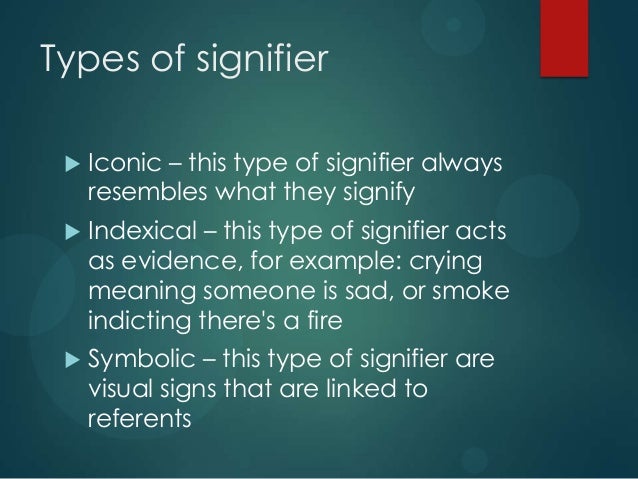
Here are the types of signifier on a powerpoint slide.
 Here is the picture I have taken, simply it is of a mug a pen and a old piece of paper with some crumbs on the table. As this looks innocent there is still a lot of meaning behind it, the cup of coffee suggests someone has been up late as the back ground is dark. This may be due to someone staying up late working and being stressed and this is apparent because of the pen and paper. Also the discoloration of the paper may suggest it has been there for a long time and is a long term problem.
Semiotics;
Semiotics are frequently used in advertising to put a message across using signs and symbols. A sign can also be seen as a signifier, or a symbol that represents something else. In some cases the sign can be an exact representation of the thing being signified, whereas in other cases it may present connotations of another meaning.
Example of essay on semiotics; http://www.aber.ac.uk/media/Students/awc9401.html

Here is my analysis of my image. I have added a lot of detail about mis en scene and why everything in this photo is there for a reason.
Conventions of television drama
-Usually runs week in, week out, all year round.
-It has a continuous story lines often dealing with domestic themes or personal or family relationships.
-They often have a well known theme tune which is played at the beginning and may have been changed a little over the years.
-There is a limit to the number of characters on at one time which allows the audience to focus on a small number of characters.
-We often see both good and bad characters in the show.
-The plots are also often open ended which means that they featured or interlinked on the next episode.
-It is often made so that the audience can relate to the setting of the television show by using common settings.
-The themes that are used in TV dramas are often ones that are exaggerated, but realistic enough so that we can relate to them. We also see themes of relationships and violence as they are two things that the audience are likely to experience or witness and conflict within dramas provides excitement and allows the audience to sympathise with a particular character / characters.
-Camera work that is always seen in continuing editing is conventional and always seen in TV dramas.
Types of groups in TV Drama Issues that surround the representation of different types of groups in TV Drama.
Age
Representational issues for the ages of 13 to 19 being the teenage years include issues such as; rude, rebellious, naive, dependent, and vulnerable. As well as teenagers there can also be issues regarding the older age such as; weak, vulnerable, dependent and boring. There can also be positives for both for example, the old can be wise with authority and teenagers or children can been seen as innocent and active or sociable.
Race
Issues that surround race and ethnicity can be for instance that young black, hooded boys can be seen as trouble or criminals, yet the older generation are seen as patriarchal and religious, this is within the British and American TV dramas having both extremes. Asian communities can often be linked with religion, and most commonly have a career within the catering industry. These communities are often large,
Gender
Women are generally represented in a narrow range of social roles in TV drama, whilst men are shown performing a full range of social and occupational roles. The representations Of women emphasise women’s Domestic, sexual, consumer and marital activities to the exclusion of all else. TV dramas generally ignore the fact that a majority of British women go out to work. Men, on the other hand, are seldom presented nude or defined by their marital or family status. Workingwomen are often portrayed as unfulfilled, unattractive, possibly unstable and unable to sustain relationships. It is often implied that working mothers, rather than working fathers, are guilty of the emotional neglect of their
Disability
In need of pity and charity – Barnes claims that this stereotype has grown in popularity in recent years because of television appeals such as Children in need. As victims - when people with disabilities are featured in television drama, they are three times more likely than able-bodied characters to be killed off. As villains –
People with disabilities are often portrayed as criminals or monsters, e.g. villains in James Bond films often have a physical impairment. As super-cripples – Ross notes that disability issues have to be sensational, unexpected or heroic in order to be interpreted by journalists as newsworthy and reported on. As a burden – Television documentaries and news features often focus on carers rather than the people with disabilities.
Class
Neo-Marxists argue that mass media representations of social class tend to celebrate hierarchy and wealth. Those who benefit from these processes, for example the monarchy, the upper class and the very wealthy, generally receive a positive press as celebrities who are somehow deserving of their position. The British mass media hardly ever portray the upper classes in a critical light, nor do they often draw any serious attention to inequalities in wealth and pay or the overrepresentation of public-school products in positions of power.
Regional Identity
The television coverage of ethnic minorities over focuses on
Crime, AIDS in Africa and Black children’s under-achievement in schools, whilst ignoring the culture and interests of a huge Black audience and their rich contribution to British society. So the majority of the time it is negative towards regional identity.
Key Terms
TV Drama - A television drama is an acted story that tells about emotion, and conflict through dialogue and action. The origin of drama can be traced back during the renaissance, with some of the greatest playwrights like William Shakespeare.
Mediation - a process media goes through to alter information
Hegemonic Norm – the idea that to certain people, this is the normal attitude or religious ideal in the group. For example Christianity in England.
Ideology - An ideology is a world view, a system of values, attitudes and beliefs which an individual, group or society holds to be true or important; these are shared by a culture or society about how that society should function.
Semiotics – the study of sign processes, sign and symbols, or signification and communication.
Connotation – the feeling and thoughts we associate with a word.
Signifier – a signs physical from (such as sound, printed word, or image) as distinct from its literal meaning.
Iconic Signifier – signs where the signifier represents the signified E.g a picture.
Stereotype – are widely held but fixed and oversimplified image or idea of a particular person or thing. Representation – all about understanding the choices that are made when it comes to portraying something or someone in a mass media text.
Binary Opposites - where texts are organised around sets of opposite values such as good and evil, light and dark.
Mode of address – the way in which media texts talk to the audience.
Anchoring – the copy of text anchors the meaning of an image, such as a rose for a dating ad.
Conventions - Conventions are the generally accepted ways of doing something.

No comments:
Post a Comment